Account Monitoring
Catch portfolio risk across personal or commercial accounts
Credit bureau powered account monitoring
Monitor personal or commercial accounts across all three bureaus, one account at a time or your entire book. CRS surfaces early risk signals so you can act while there is still time, through a single request or scheduled batch.
This is built for lenders and platforms that need earlier signals than delinquency so they can intervene, adjust policy, and manage exposure before risk becomes loss.
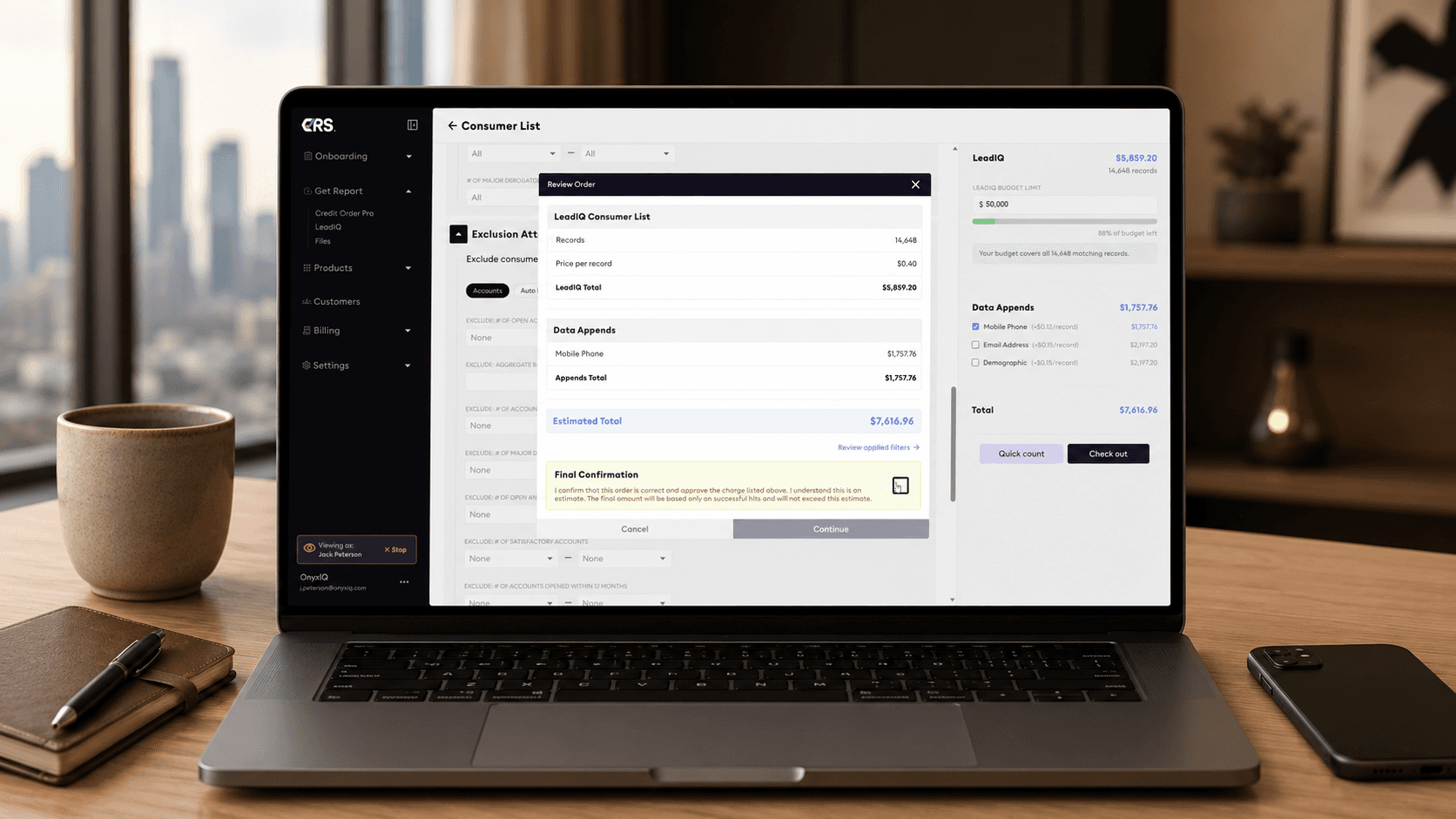
Account monitoring keeps a continuous watch on the accounts in your portfolio and alerts you when something material changes, including score movement, new inquiries, new tradelines, rising utilization, delinquencies, and public records.
Data sources and coverage
- Pull from Equifax, Experian, and TransUnion
- Tax return data and monitoring services
- Bankruptcy, lien and judgement alerts as well as other key KYC/KYB signals
- Monitor personal or commercial accounts
Monitoring one account or your entire book
- Run a single Account Review to check an account
- Schedule batch Portfolio Monitoring to refresh your whole portfolio on a recurring basis
Learn how ongoing account monitoring helps lenders stay ahead of risk
This conversation breaks down why credit risk does not stop after onboarding. Hear how continuous monitoring can help teams identify material changes earlier, respond with more confidence, and protect portfolio performance over time.
View podcastTrusted by


Risk does not wait for your next review cycle
Monitoring that scales with your portfolio
Monitor personal or commercial accounts across all three bureaus
FAQ
Why is account monitoring becoming more important in today’s macro environment
Because risk can shift faster than traditional reporting cycles. Utilization changes, new credit seeking, and other early signals often show up before delinquency. Monitoring helps teams respond while there is still time to intervene, adjust policy, or rebalance exposure.
How is this different from eCredit Monitoring?
eCredit Monitoring is consumer-facing. Your customers log in to track their own credit. Account monitoring is internal. Your risk, servicing, or portfolio team uses it to watch the accounts you hold. One is a customer engagement tool, the other is a risk management tool, and they are often deployed by the same organization for entirely different purposes.
Why does tri-bureau monitoring matter for risk management specifically?
Creditors do not all report to all three bureaus, and they do not report on the same schedule. A new delinquency, a maxed-out card, or a new loan can appear on one bureau's file days or weeks before another. For early-warning purposes, that lead time is exactly what you are paying for, so monitoring more bureaus means catching deterioration sooner. Single-bureau monitoring is more economical and is often sufficient for stable, low-risk segments, while tri-bureau is the stronger choice for higher-risk segments where early detection has real dollar value.
What signals can monitoring track, and which ones actually predict default?
Monitoring can flag score movement, new inquiries, new tradelines, utilization increases, delinquencies on other accounts, derogatory marks, bankruptcies, and public records. The most predictive early-warning signals tend to be rising utilization, new delinquencies on other obligations, and a cluster of new inquiries, because they often precede trouble on your own account. CRS lets you configure which signals trigger alerts so your team focuses on the indicators that matter for your portfolio rather than drowning in noise.
What is Batch Portfolio Monitoring for consumer accounts
Batch Portfolio Monitoring is designed for ongoing portfolio oversight evaluating many accounts at once using repeatable, scalable workflows. Use Account Review when you need a targeted decision on a single account. Use Batch Portfolio Monitoring when you need repeatable oversight across many open accounts.
How current is the data?
You control the cadence. Single requests return current data on demand. Batch monitoring refreshes on the schedule you set, which can be tightened for high-risk segments and relaxed for stable ones. The right cadence is a balance between how fast risk moves in a given segment and the cost of refreshing it.
Can we choose which attributes or events we monitor for commercial entities
Yes. For commercial use cases, CRS can monitor a full report or specific attributes to align monitoring depth and cost to your risk policy.
How should we set monitoring frequency across different parts of the portfolio?
Segment by risk velocity. Accounts in higher-risk bands, recently modified accounts, or accounts already showing soft signals justify more frequent monitoring because their risk can change quickly. Stable, seasoned, low-risk accounts can be monitored less frequently without materially increasing exposure. Tiering frequency this way concentrates spend where the early-warning value is highest, which is the core discipline of an efficient monitoring program.
What should our team actually do when an alert fires?
The value of monitoring is realized in the response, not the alert. Effective programs define the action for each signal in advance: a score drop past a threshold might trigger an account review, rising utilization plus a new inquiry might trigger proactive outreach or a line reassessment, a new delinquency elsewhere might move an account into a watch list. Mapping signals to actions before launch is what separates a monitoring program that reduces losses from one that just generates reports nobody reads.
Why do monthly or static reviews fall short for modern portfolios
Monthly pulls and manual reviews can lag behind real behavior changes, especially during seasonal spikes and volatile periods. When products, offers, and risk appetite change quickly, static monitoring creates blind spots and slows response.
How does monitoring fit alongside our origination and decisioning tools?
Monitoring is the back half of the credit lifecycle. Origination decides whether to extend credit. Monitoring watches what happens after. Together they close the loop, and using a single data provider across both means the data you decisioned on and the data you monitor against are consistent, which makes deterioration easier to spot against the original baseline.
How do we integrate account monitoring?
Account monitoring runs through the same CRS One integration as the rest of your credit data products. There is no separate endpoint to build against. You integrate with CRS One once, and we establish the account review permissible purpose on the back end, so monitoring becomes available through the infrastructure you already have. From there, the main work on your side is scheduling. For continuous monitoring, you set the batch cadence that fits each segment of your portfolio. For one-off checks, you call the same endpoint on demand whenever an account warrants a closer look. A few notes: The key correction is that this is not a "choose one of three integration paths" decision the way the source batch monitoring page framed it. It is the same CRS One endpoint with a different permissible purpose established server-side, which is a much stronger story. It means a buyer who already uses CRS for origination or any other product gets monitoring with essentially no new integration lift, just a permissible purpose configuration and some scheduling logic. I named "account review permissible purpose" explicitly since that is what you establish on the back end, and it ties cleanly to the permissible purpose FAQ answer elsewhere on the page. I framed the scheduling work honestly as the real task on the client's side, split between batch cadence for continuous monitoring and on-demand calls for one-off requests. That matches what you described and sets accurate expectations rather than implying it is fully turnkey. This also reinforces the CRS One vision you have been building. The whole premise of CRS One is one endpoint for the full lifecycle, and this answer is a concrete proof point: monitoring is not a separate product to integrate, it is the same layer with a different purpose. If you want, I can add a short clause linking to the CRS One page so the reader can see how monitoring fits the broader single-endpoint story. One thing worth confirming before this goes live: whether the one-off request scheduling is genuinely client-side work or something CRS helps configure. I wrote it as client-side ("the main work on your side is scheduling") based on what you said, but if CRS provides scheduling tooling or helps set it up, the answer could lean a little more turnkey. Want me to adjust the balance there, or add the CRS One cross-link?
What permissible purpose covers account monitoring?
Monitoring accounts where you have an existing relationship is generally conducted under the account review permissible purpose, which applies to reviewing an account in connection with an existing credit obligation or account relationship. This is a well-established basis for portfolio monitoring. CRS confirms the appropriate framework for your specific program during onboarding, since the right basis depends on your relationship to the accounts you are monitoring.