Credit Monitoring
Your Customer's Ultimate Credit Tool
Empower your customers with real-time credit insights, detailed reports, and advanced monitoring - all powered by CRS API.
Credit Monitoring for Your Customers
Credit Monitoring is a B2C credit monitoring solution that allows users to log in securely and access their own credit reports. With either 1 bureau (Equifax) or all three bureaus Equifax, Experian and TransUnion, users can track their credit scores over time and dive into detailed credit insights.
Get Started"requestData": { "firstName": "J"
"lastName": "SMITH"
"middleName": "FRANK"
"ssn": "666321234"
"addresses": [
"borrowerResidencyType": "Current"
"addressLine1": "1234 ELM STREET"
"city": "SPRINGFIELD"
"state": "IL"
"postalCode" : "62704"
] } , "repositoryIncluded": { "transunion": true,
"experian": false, "equifax": false } ,
"responseDetail": { "dateRequested":Monitoring features
Tools for Tracking Credit Health
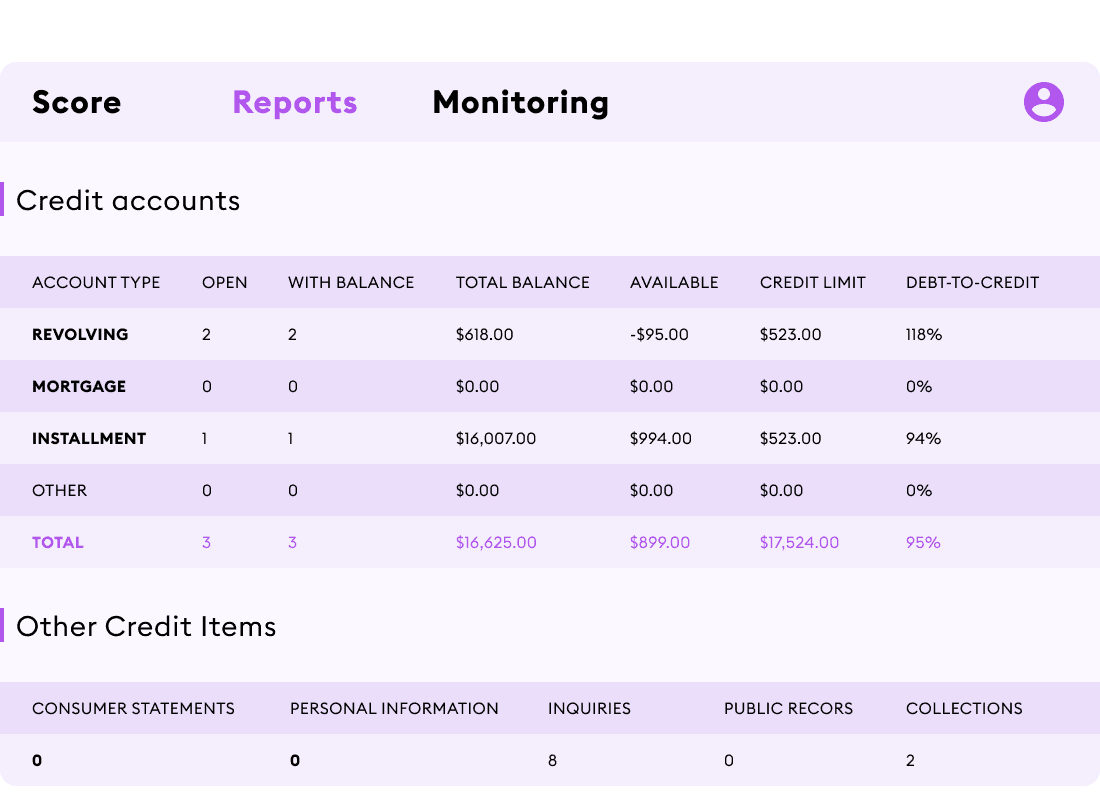
Credit Monitoring offers tools to track credit health. Users can view score trends, available credit, usage %, inquiries, accounts, and more in a detailed Credit Summary. The Report Tab provides insights into balances, limits, and collections, while the Monitoring Tab delivers alerts and monthly updates. PDF downloads are also available.
Easy Integration Options
Integration Made Simple—Your Choice, Your Branding
Time to live
iFrame Widget
About 30 minutes
Is a fast solution, requiring only a simple copy-paste of the iFrame code into your HTML. It’s ideal for businesses needing rapid deployment without developers.
Time to live
Hybrid Widget
Roughly one day
Combines API endpoints with the iFrame for seamless login and improved user experience. Perfect for quick and user-friendly integration.
Time to live
Full API Integration
About two weeks
Offers full customization for your app or website, ideal for businesses with development teams. It allows complete branding and tailored interfaces.
The CRS Advantage
Speed and Simplicity. CRS eliminates the need to integrate directly with bureaus, which can be resource intensive. Get your product live in as little as 30 minutes with our iFrame widget or fully integrated within two weeks.
<html>
<head>
<title>eCredit Monitoring</title>
<meta name="description" content="CRS Consumer Credit Reports"/>
<link rel="icon" href="/favicon.ico">
<style>
body { background: #F9FAFB; }
#sc-iframe { border:none;overflow:hidden;padding:0px;margin:0px;
width:100%;height:100vh;z-index:1;position:absolute;left:0;top:0; }
</style>
</head>
<body>
<iframe id="sc-iframe"
src="https://efx-dev.stitchcredit.com/api/users/start?key=[API-KEY]&ocf=[FLAGS]&oct=[COLOR]&view=[VIEW-OPTION]&ocl=[LOGO-URL]"
width=“100%” height=“100vh”>
</iframe>
</body>
</html>


- Branded to you
Tailor our white-label credit monitoring widget’s appearance to seamlessly align with your brand’s visual identity, and make stronger, more personalized connections with your customers.
Learn more- Diverse credit data
Provide comprehensive credit data, including VantageScore credit scores, the top four score factors, score history trends, and real-time credit reports upon enrollment.
Learn more- Daily credit tracking
Get alerts to changes in customers’ credit files through both single-bureau or tri-bureau credit file monitoring options, and ensure timely action to protect the credit well-being of your client base.
Learn more
Own the customer relationship after the decision
Ready to get started?
Selecting the right credit product, navigating compliance, and implementing your solution has never been easier.
FAQ
What is the difference between credit monitoring and a credit report pull?
A credit report pull is a single snapshot of a consumer's file at one moment. Credit monitoring is an ongoing service that watches the file over time and alerts the consumer when something changes, such as a new account, a new inquiry, a balance shift, or a derogatory mark. The value of monitoring is not the data at any single point. It is the continuity, the alerting, and the engagement that comes from a consumer checking in regularly.
Is eCredit Monitoring a B2C or B2B product?
Both, structurally. You access it as a B2B platform through CRS, and you offer it to your customers as a consumer-facing tool under your own brand. CRS provides the data and infrastructure. You own the customer relationship, the brand experience, and the decision about how monitoring fits into your product.
What is the difference between single-bureau and tri-bureau monitoring?
Single-bureau monitoring (Equifax) watches one credit file. Tri-bureau monitoring watches all three (Equifax, Experian, and TransUnion). Single-bureau is more cost-effective and is often sufficient for general score tracking and engagement. Tri-bureau is the stronger choice when your customers are actively managing their credit toward a goal, such as qualifying for a mortgage or auto loan, because lenders pull from different bureaus and a change can appear on one file before another. Many programs start single-bureau for breadth and offer tri-bureau as a premium tier.
Why do scores differ between bureaus, and how do we explain that to customers?
Each bureau maintains its own file, and not every creditor reports to all three. A customer may see different scores across bureaus because the underlying data differs, not because one is wrong. This is one of the most common questions consumers ask, and a good monitoring experience explains it proactively. CRS surfaces the score factors alongside the score so customers understand what is driving the number rather than just seeing it move.
Why might a customer's monitoring score differ from the score a lender used to decline them?
Consumers frequently see one score in a monitoring tool and a different score when a lender makes a decision. This happens because lenders often use different score models (including industry-specific or older FICO versions) and pull from different bureaus at different moments. The monitoring score is an accurate directional indicator of credit health and movement, but it is an educational score, not necessarily the exact model a given lender will use. Setting that expectation in your customer-facing copy prevents confusion and support tickets.
What does "top four score factors" actually give the customer?
The score factors tell the customer why their score is what it is, for example high utilization, a recent late payment, a short credit history, or too many recent inquiries. This is the part of monitoring that turns a passive number into an actionable tool. A customer who sees that utilization is their top factor knows exactly what to do to improve, which is what keeps them coming back to track progress.
How does credit monitoring actually drive retention?
Most financial products are transactional and give the customer no reason to return between events. Monitoring creates a recurring reason to log in, often monthly or more, which keeps your brand in front of the customer continuously. That sustained engagement is what lets you re-market your next product at the right moment, and it is why monitoring is increasingly treated as a retention and lifecycle tool rather than a standalone offering.
What engagement cadence should we expect from a monitoring program?
Engagement is driven primarily by alerts and score updates. Customers tend to log in when something changes in their file or when a new score posts, so the alerting experience is the engine of the program. Programs that lean into meaningful, well-timed alerts (a new account, a score increase, a resolved collection) see materially higher return rates than programs that simply offer a dashboard and wait for the customer to remember it exists.
How does monitoring fit into a declined-applicant or "second look" strategy?
A declined applicant is an acquisition cost you have already paid. Enrolling them in your branded monitoring experience keeps the relationship alive, gives them a path to improve, and positions you as the brand they return to when they qualify. This is one of the highest-ROI uses of monitoring because the alternative is a dead lead. The enrollment should be consumer-initiated with appropriate consent, and it pairs naturally with eligibility products at the top of the funnel.
Can monitoring support a credit-building or financial-wellness program?
Yes. Monitoring is the measurement layer underneath any credit-building program. When you offer customers tools or guidance to improve their credit, monitoring is how they (and you) see the progress. That feedback loop, take an action, watch the score respond, is what makes financial-wellness programs sticky. Pairing monitoring with data furnishing, where positive payment behavior is reported back to the bureaus, closes the loop completely.
Do we need to integrate with the bureaus directly?
No, and that is the core of the CRS advantage. Direct bureau integration is slow, resource-intensive, and carries significant compliance and contractual overhead. CRS maintains the bureau relationships and the data normalization, so you integrate once with CRS and offer monitoring without ever negotiating a bureau contract or building a bureau connection.
What permissible purpose covers consumer credit monitoring?
Credit monitoring is generally on firmer footing than many credit products because the consumer is accessing their own credit information and has enrolled and consented to the service. That consumer consent is the basis for the data access. CRS works with you during onboarding to confirm the right framework for your specific implementation, since the details depend on how you enroll customers and how monitoring is positioned within your product.
Does checking their own credit through monitoring affect a customer's score?
No. Monitoring relies on soft inquiries, which are visible only to the consumer and do not affect the credit score. Customers can check as often as they like with no impact, which is exactly what makes frequent, habitual engagement possible.
What are our obligations around the data customers see and dispute?
When a consumer believes information in their file is inaccurate, they have the right to dispute it with the bureau under the FCRA. A monitoring experience should make consumers aware of that right and direct them to the proper dispute channel. CRS provides the data and supports compliant workflows, but the dispute process itself runs through the bureaus and the furnishers of the data, and your customer-facing experience should set that expectation clearly.
Why does identity verification matter at enrollment?
Because monitoring gives a logged-in user ongoing access to a full credit file, verifying that the enrolling person is who they claim to be is essential. Strong identity verification at enrollment protects the consumer from someone else accessing their credit data and protects your program from fraud. This is why robust authentication is a feature of the monitoring experience, not an afterthought.